CoinJoin Mixer: A Practical Guide to CoinJoin Transactions and Bitcoin Privacy
Learn how a Coinjoin Mixer works, explore Coinjoin Transactions, and understand Coinjoin Crypto with a simple guide to Coinjoin Transaction privacy.
October 6, 2026
CoinJoin Mixer: A Practical Guide to CoinJoin Transactions and Bitcoin Privacy
Bitcoin is often described as a private form of digital money, but the reality is more nuanced. Bitcoin transactions are recorded on a public blockchain, meaning anyone can inspect transaction histories, wallet addresses, amounts, and movement of funds.
This transparency is one of Bitcoin's most important characteristics, but it can also create privacy concerns for people who do not want their financial activity to be easily connected across transactions.
This is where a Coinjoin Mixer can become relevant.
CoinJoin is a privacy technique designed to make blockchain transaction analysis more difficult by combining inputs from multiple participants into a coordinated transaction. Instead of having a straightforward relationship between individual inputs and outputs, the transaction creates ambiguity about which input corresponds to which output.
Understanding how this works is important before evaluating any privacy technology. CoinJoin does not make Bitcoin transactions disappear from the blockchain. The transactions remain publicly recorded, but the relationship between inputs and outputs can become harder to determine.
What Is CoinJoin?
CoinJoin is a Bitcoin transaction technique in which multiple users participate in a single coordinated transaction. The transaction combines several inputs and creates multiple outputs, making it more difficult for an outside observer to confidently determine which participant's input corresponds to a particular output.
In a conventional Bitcoin transaction, the flow of funds can sometimes be relatively straightforward to follow. Blockchain analysis tools can examine addresses, transaction histories, timing, amounts, and other characteristics to identify relationships.
With CoinJoin, multiple participants contribute inputs to the same transaction. The resulting structure introduces additional uncertainty into that analysis.
This is why Coinjoin Crypto is generally discussed in the context of Bitcoin privacy rather than as a method of hiding transactions from the blockchain itself.
How Does a CoinJoin Transaction Work?
A Coinjoin Transaction can be understood through a simple example.
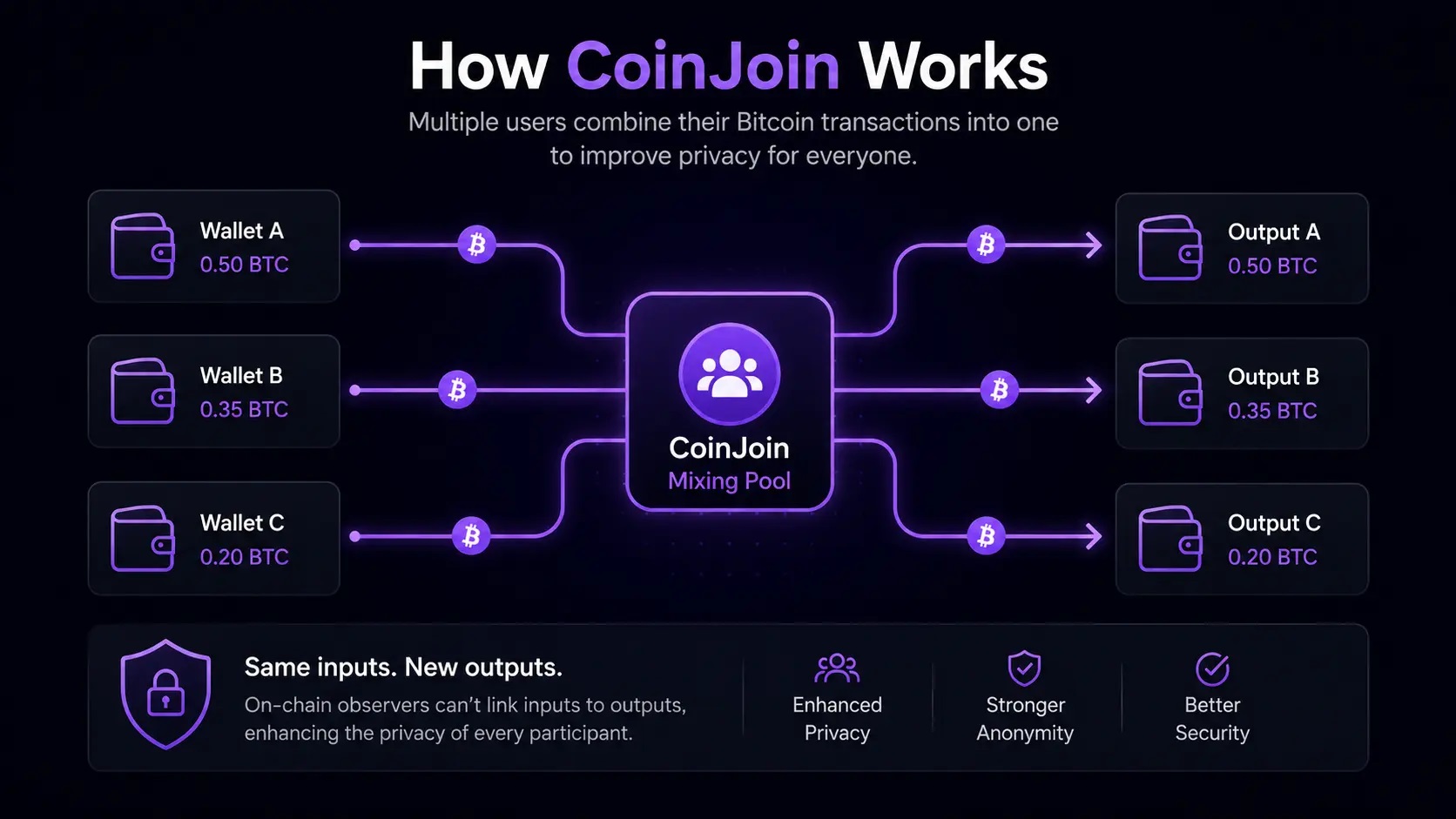
Imagine several Bitcoin users want to improve the privacy of their transactions. Each participant provides one or more inputs. These inputs are combined into a coordinated Bitcoin transaction containing multiple outputs.
An observer can see that Bitcoin entered the transaction and that Bitcoin left it. What becomes more difficult is determining with certainty which specific input funded which specific output.
The basic concept can be represented as:
Multiple Bitcoin inputs → Coordinated CoinJoin transaction → Multiple Bitcoin outputs
The privacy benefit comes from the uncertainty created by this structure. The larger and better-constructed the participant set, the more difficult certain forms of transaction analysis may become.
However, privacy is not simply determined by the transaction itself. Wallet practices, transaction amounts, timing, address reuse, future spending behavior, and other on-chain activity can also influence how much privacy a user actually achieves.
CoinJoin Explained: Why Bitcoin Is Not Automatically Private
One of the most common misunderstandings about Bitcoin is that using a new wallet address automatically makes transactions private.
Bitcoin is better described as pseudonymous rather than completely anonymous. Your real-world identity may not appear directly beside a blockchain transaction, but addresses and transaction histories are publicly visible.
For example, suppose a wallet address becomes associated with a person's identity through an exchange, payment, public donation address, or another source. Blockchain observers may then examine previous and subsequent transactions connected with that address.
This is where Coinjoin Explained becomes particularly useful for understanding Bitcoin privacy.
CoinJoin is designed to introduce additional ambiguity into the transaction graph. It does not erase blockchain records, and it does not guarantee that every transaction becomes impossible to analyze.
CoinJoin Transactions and Blockchain Analysis
Blockchain transactions are permanent records. Anyone can inspect the public ledger and use analytical techniques to study how Bitcoin moves between addresses.
Traditional blockchain analysis can look at factors such as:
- Transaction inputs and outputs
- Wallet address relationships
- Transaction timing
- Transaction amounts
- Repeated address usage
- Spending patterns
- Connections between known entities
CoinJoin changes the structure available to an analyst by bringing multiple participants into the same transaction.
For example, if five people independently send Bitcoin to five different recipients, the relationships may be easier to model. When their inputs and outputs are coordinated within a CoinJoin transaction, the analyst may have several possible interpretations rather than one obvious path.
This distinction is important. CoinJoin creates uncertainty. It does not remove the underlying Bitcoin transaction from the public blockchain.
What Makes a Coinjoin Mixer Different From a Traditional Bitcoin Transaction?
A normal Bitcoin transaction often has a relatively direct structure. One wallet spends Bitcoin and another wallet receives it.
A Coinjoin Mixer based on CoinJoin uses a different approach by coordinating multiple participants and transactions.
The objective is to make the connection between a user's previous coins and subsequent outputs less obvious to an external observer.
This can be useful for individuals who consider financial privacy important. For example, a business may not want competitors to easily analyze its payment activity, while an individual may prefer not to expose their complete spending history simply because someone knows one of their Bitcoin addresses.
Privacy can therefore be viewed as a legitimate part of financial security, rather than simply an attempt to conceal activity.
CoinJoin Crypto and the Importance of Transaction Structure
The effectiveness of CoinJoin depends heavily on how the transaction is constructed and how participants behave afterward.
Several factors can influence privacy outcomes.
1. Number of Participants
More participants can create a larger set of possible relationships between inputs and outputs. This can make certain forms of analysis more difficult.
2. Output Patterns
Standardized or similar output values can help create ambiguity. Unequal or unusual amounts may sometimes provide additional information to an analyst.
3. Address Reuse
Reusing addresses can undermine privacy by creating additional links between transactions. Good Bitcoin privacy practices therefore involve careful address management.
4. Future Transactions
Privacy does not end when a CoinJoin transaction is completed. How coins are later spent can create new links or reveal patterns that affect the overall privacy of the transaction history.
A Practical Example of a Coinjoin Transaction
Consider four Bitcoin users who each want to improve the privacy of their holdings.
User A contributes Bitcoin from Wallet A. User B contributes from Wallet B. User C contributes from Wallet C, while User D contributes from Wallet D.
Instead of processing four completely separate transactions, their inputs can participate in one coordinated CoinJoin transaction containing multiple outputs.
After the transaction is confirmed, an external observer can see the combined transaction on the blockchain. However, determining exactly which original input belongs to which resulting output may be less straightforward.
This is the central idea behind CoinJoin.
The blockchain remains transparent, but the transaction structure introduces uncertainty into the interpretation of that transparency.
Is CoinJoin the Same as Bitcoin Anonymity?
No. CoinJoin and complete anonymity are not the same thing.
A Coinjoin Mixer can help reduce certain types of on-chain traceability, but no privacy technique should be treated as an absolute guarantee of anonymity.
Bitcoin privacy depends on the complete transaction lifecycle. Wallet configuration, transaction history, address reuse, timing, amounts, counterparties, and subsequent spending can all affect what information remains observable.
For this reason, users should understand CoinJoin as a privacy-enhancing technique rather than a promise that blockchain activity can never be analyzed.
CoinJoin and Responsible Bitcoin Privacy
Financial privacy has practical value. People may reasonably want to prevent unnecessary exposure of their balances, spending patterns, business relationships, or transaction history.
At the same time, cryptocurrency users should understand the legal and regulatory requirements that may apply to their transactions and jurisdiction.
A responsible approach to Bitcoin privacy involves understanding how the technology works, reviewing the risks, maintaining secure wallets, protecting private keys, and following applicable laws.
Privacy technology should be evaluated based on what it actually does rather than exaggerated claims about being completely untraceable.
Why CoinJoin Matters for Bitcoin Privacy
Bitcoin's public ledger provides transparency, auditability, and verification, but that same transparency can expose transaction relationships that users may prefer to keep private.
CoinJoin offers a technical approach to reducing some of those relationships by combining multiple participants within coordinated transactions.
For anyone researching Coinjoin Crypto, the most important concept to understand is that privacy comes from reducing certainty in transaction analysis, not from deleting blockchain records.
When used as part of a broader privacy strategy, CoinJoin can make the transaction graph more difficult to interpret while Bitcoin continues to operate according to its normal consensus rules.
That balance between public verification and improved financial privacy is what makes CoinJoin an important topic in the wider discussion around Bitcoin privacy.
Frequently Asked Questions
What is a Coinjoin Mixer?
A Coinjoin Mixer is a Bitcoin privacy service or system that uses CoinJoin-style transaction coordination to combine inputs from multiple participants and create outputs that are more difficult to associate with individual inputs.
What is a Coinjoin Transaction?
A Coinjoin Transaction combines Bitcoin inputs from multiple participants into a coordinated transaction with multiple outputs. This structure can make it harder to determine which input corresponds to a particular output.
What is Coinjoin Crypto?
Coinjoin Crypto refers to the use of CoinJoin technology within cryptocurrency, particularly Bitcoin, to improve transaction privacy by introducing uncertainty into the relationship between transaction inputs and outputs.
Does CoinJoin make Bitcoin completely anonymous?
No. CoinJoin is a privacy-enhancing technique, not a guarantee of complete anonymity. Blockchain activity remains publicly recorded, and transaction history, wallet behavior, timing, amounts, and subsequent spending can still provide information for analysis.
Why are Coinjoin Transactions useful for Bitcoin privacy?
Coinjoin Transactions can make blockchain analysis more difficult by combining multiple participants within the same transaction. Instead of creating one obvious relationship between an input and an output, the transaction can create multiple possible interpretations.
How does CoinJoin work?
CoinJoin coordinates inputs from multiple Bitcoin participants into a single transaction containing multiple outputs. The resulting transaction remains visible on the blockchain, but identifying the exact relationship between individual inputs and outputs can become more difficult.
What should users understand before using CoinJoin?
Users should understand that CoinJoin improves certain aspects of transaction privacy but does not guarantee complete anonymity. They should also consider wallet security, address management, future spending behavior, applicable regulations, and the privacy practices of any service they use.