Privacy Enhancing Technologies: A Practical Guide to Digital Privacy and Data Protection
Explore privacy enhancing technologies, zero knowledge proofs, and privacy by design to protect sensitive data and improve digital privacy.
October 13, 2026
Privacy Enhancing Technologies: A Practical Guide to Digital Privacy and Data Protection
Every digital interaction creates opportunities for information to be collected, processed, and shared. From browsing websites and using mobile applications to completing online transactions, individuals leave behind digital information that may reveal details about their activities, preferences, and identities.
As digital services become more interconnected, protecting sensitive information requires more than traditional security measures. Organizations need practical ways to reduce unnecessary data exposure while continuing to provide useful online services.
This is where Privacy Enhancing Technologies become important. These technologies and methods help organizations and individuals manage information more responsibly, minimize privacy risks, and support secure digital interactions.
By combining technical safeguards with responsible data management, businesses can strengthen privacy without unnecessarily limiting the functionality of their digital services. Understanding these technologies is an important step toward building a safer and more privacy-conscious digital environment.
What Are Privacy Enhancing Technologies?
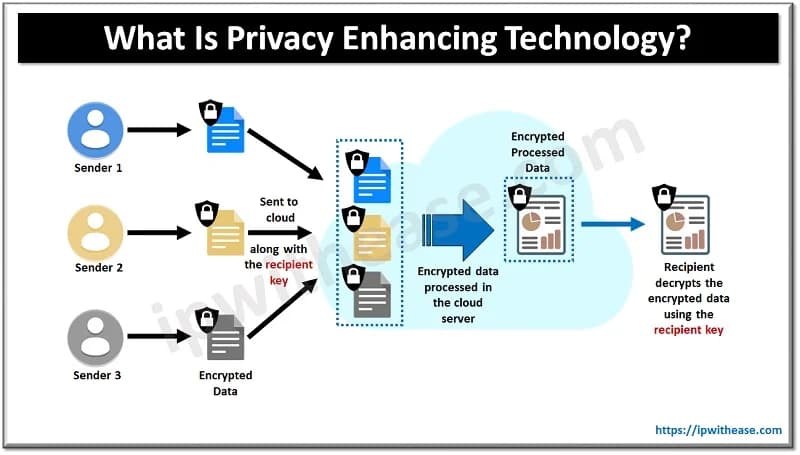
Privacy Enhancing Technologies (PETs) are technologies, techniques, and systems designed to protect personal or sensitive information while allowing data to be processed, analyzed, or exchanged for legitimate purposes.
Traditional security measures often focus on preventing unauthorized access to information. Privacy-enhancing approaches go further by reducing the amount of information that needs to be revealed, limiting the exposure of sensitive data, or enabling certain operations without disclosing underlying information unnecessarily.
Examples of Privacy Enhancing Technologies include:
- Zero-knowledge proofs: Cryptographic methods that can demonstrate the validity of a statement without revealing the underlying information required to establish it.
- Data anonymization: Techniques that remove or transform identifying information, although re-identification may remain possible depending on the data and method used.
- Pseudonymization: Replacing direct identifiers with alternative identifiers to reduce direct identification risks.
- Encryption: Protecting information so that it cannot be readily understood without the appropriate decryption key.
- Secure multi-party computation: Allowing multiple parties to calculate results using their respective inputs without necessarily revealing those inputs to one another.
- Differential privacy: A mathematical approach that limits how much an analysis reveals about any individual in a dataset.
- Privacy-preserving analytics: Methods for extracting useful insights while limiting the disclosure of individual-level information.
The most suitable technology depends on the type of information involved, the purpose of processing, the potential threats, and the level of privacy required.
Why Privacy Enhancing Technologies Matter
Organizations increasingly depend on digital information to improve services, identify suspicious activity, understand customer behavior, and support business operations. However, collecting and processing more information can also introduce additional privacy risks.
Sensitive information may be exposed through compromised accounts, poorly configured systems, excessive employee permissions, third-party integrations, or unnecessary data retention. Even when organizations apply conventional security controls, excessive access to personal information can create avoidable risks.
Privacy Enhancing Technologies can help address these challenges by reducing the need to disclose raw information, limiting access to sensitive records, and supporting more controlled data processing.
For example, a digital service may need to confirm that a user meets a particular eligibility requirement. Depending on the system, it may be possible to verify that requirement without sharing the user's complete identity details with every participating service.
This approach can reduce unnecessary disclosure while allowing the service to perform its intended function.
However, privacy technologies are not automatic guarantees of security. Their effectiveness depends on correct implementation, appropriate system design, sound key management, and an understanding of the threats they are intended to address.
Understanding Zero Knowledge Proofs
Zero Knowledge Proofs are cryptographic techniques that allow one party to demonstrate that a statement is true without revealing the underlying information beyond what the proof itself establishes.
In simple terms, a zero-knowledge proof can help verify a claim without requiring the person making the claim to disclose all the information associated with it.
Imagine an online service that needs to verify whether a user meets a specific age requirement. In an appropriately designed system, a zero-knowledge proof could establish that the requirement is satisfied without revealing the user's complete date of birth.
This can be useful in digital identity systems, blockchain applications, authentication workflows, and other environments where verification is necessary but unnecessary disclosure should be avoided.
Zero-knowledge proofs generally aim to provide three important properties:
- Completeness: A valid statement can be successfully demonstrated by an honest prover using the required information.
- Soundness: An invalid statement should not be accepted except with a limited probability under the scheme's security assumptions.
- Zero knowledge: The verification process reveals no additional information about the underlying secret beyond what is permitted by the proof and the statement being verified.
These properties make zero-knowledge proofs valuable for applications that need reliable verification while limiting information exposure.
Nevertheless, the surrounding system still matters. A zero-knowledge proof does not automatically hide network metadata, protect a compromised device, prevent every form of tracking, or guarantee that all application data remains private.
Privacy By Design: Building Privacy Into Digital Systems
Privacy By Design is an approach that incorporates privacy considerations into the planning, development, deployment, and maintenance of products and services.
Instead of treating privacy as a final compliance task, organizations consider data protection from the beginning of a project's lifecycle.
For example, a company developing a customer application can evaluate which information is essential before creating its registration process. It can also determine how sensitive information will be stored, which employees need access, how long records should be retained, and how users can exercise applicable privacy rights.
Practical Privacy By Design principles include:
- Data minimization: Collect only the information necessary for a defined and legitimate purpose.
- Purpose limitation: Use information in ways consistent with the purposes for which it was collected and applicable requirements.
- Access control: Restrict information access according to individual responsibilities and business needs.
- Secure defaults: Configure systems to provide appropriate privacy protections without requiring users to discover and enable every important setting themselves.
- Lifecycle management: Define how information is collected, used, retained, archived, and securely deleted.
- Privacy testing: Evaluate how system changes, integrations, and new features affect information exposure.
Privacy By Design works best when technical teams, product managers, security professionals, legal specialists, and business stakeholders collaborate throughout development.
Organizations can also consult the NIST Privacy Framework for guidance on identifying and managing privacy risks.
Digital Privacy Solutions for Modern Businesses
Businesses need practical approaches to protecting information across websites, cloud platforms, mobile applications, customer databases, and third-party services.
Digital Privacy Solutions combine technologies, policies, and operational procedures to help organizations manage these responsibilities effectively.
Depending on business requirements, an effective privacy strategy may include the following measures:
- Encryption in transit and at rest: Protect information as it moves between systems and while it is stored.
- Identity and access management: Ensure that users and employees can access only the information and functions they are authorized to use.
- Privacy-preserving analytics: Use appropriate techniques to extract insights while reducing unnecessary exposure of individual-level data.
- Data loss prevention: Identify and help prevent unauthorized transfers of sensitive information.
- Consent and preference management: Record and respect user choices where consent or other applicable privacy requirements call for it.
- Data retention controls: Apply defined retention periods and securely dispose of information when it is no longer required.
- Vendor privacy assessments: Evaluate how third-party providers collect, process, store, and protect shared information.
Selecting the right combination requires an understanding of business processes and the risks associated with the information being handled. A small website may need different controls from a financial platform or a large organization processing sensitive customer records.
The goal is to apply proportionate safeguards that support legitimate business activities without creating unnecessary privacy exposure.
Digital Privacy Protection for Individuals
Organizations play an important role in protecting personal information, but individuals can also reduce their exposure through informed digital habits.
Digital Privacy Protection involves practical measures thathelp people manage their online information, protect accounts, and reduce the risk of unauthorized access or unwanted disclosure.
Useful practices include:
- Use strong, unique passwords for important accounts and store them in a reputable password manager.
- Enable multi-factor authentication wherever available.
- Review browser settings, application permissions, and account privacy controls regularly.
- Avoid sharing unnecessary personal details on public websites and social platforms.
- Keep devices, browsers, and applications updated with security fixes.
- Check website addresses carefully before entering credentials or payment information.
- Understand what information a digital service collects and how it may be shared.
- Use encrypted connections and trusted communication services when appropriate.
- Review account activity and respond promptly to unfamiliar login alerts.
- Remove unused applications and close accounts that are no longer needed when practical.
These practices do not eliminate every privacy risk, but they can reduce common opportunities for account compromise and unnecessary information exposure.
It is also important to remember that privacy and security are related but different. A secure account can still share more personal information than necessary, while a privacy-focused service can still be vulnerable to technical attacks.
How Privacy Enhancing Technologies Support Cryptocurrency Privacy
Cryptocurrency and blockchain applications introduce specific privacy challenges because transactions may be recorded on publicly accessible ledgers.Depending on the blockchain, transaction details and wallet addresses can remain visible for extended periods.
Although wallet addresses do not necessarily display a person's real-world identity, transaction patterns and information from other sources may sometimes be used to connect blockchain activity with identifiable individuals.
Privacy Enhancing Technologies can help address certain challenges in blockchain environments by limiting the information disclosed during transactions, supporting confidential computations, or allowing users to demonstrate that specific requirements are satisfied without revealing unnecessary details.
Zero-knowledge proofs are one example. Certain blockchain systems use them to verify transaction conditions or application rules while limiting disclosure of underlying information.
Other privacy approaches may include encryption, selective disclosure of credentials, and carefully designed systems that reduce the connection between personal identity and transaction-related information.
However, privacy protections vary considerably across implementations. Public transaction metadata, wallet reuse, compromised devices, application logs, and third-party services may still reveal information.
Users should therefore evaluate the actual privacy properties of a cryptocurrency service instead of assuming that blockchain technology automatically provides anonymity.
Challenges and Limitations of Privacy Enhancing Technologies
Although Privacy Enhancing Technologies offer important benefits, implementing them effectively can involve technical, operational, and organizational challenges.
Common considerations include:
- Implementation complexity: Advanced cryptographic techniques can require specialized knowledge, careful testing, and ongoing maintenance.
- Performance requirements: Some privacy-preserving computations require additional processing time, computing resources, or communication between systems.
- Integration challenges: Existing applications may need architectural changes before privacy-enhancing methods can be introduced effectively.
- Configuration risks: Incorrect implementation or weak key management can undermine otherwise strong privacy protections.
- Residual identification risks: Removing direct identifiers does not always prevent people from being identified through combinations of information.
- Governance and compliance: Organizations must assess how privacy technologies interact with applicable laws, retention obligations, security requirements, and user rights.
These challenges do not make privacy-enhancing approaches less valuable. Instead, they highlight the importance of selecting technologies based on specific use cases, conducting appropriate risk assessments, and testing systems before deployment.
Organizations should also reassess their controls periodically as technologies, threats, regulations, and data-processing practices evolve.
How to Choose the Right Privacy Enhancing Technologies
There is no single privacy technology that addresses every threat. Choosing an effective solution begins with identifying the information being processed and understanding what needs to remain confidential.
A practical selection process can follow these steps:
- Identify sensitive information: Determine which personal, financial, account, or transaction-related records require protection.
- Define the privacy objective: Decide whether the priority is reducing data collection, limiting disclosure, protecting stored information, or enabling analysis without exposing individual records.
- Assess potential threats: Consider unauthorized access, insider risks, third-party exposure, re-identification, and metadata leakage.
- Compare suitable technologies: Evaluate encryption, zero-knowledge proofs, differential privacy, pseudonymization, and other techniques according to the use case.
- Review operational requirements: Consider implementation costs, performance, maintenance, integration, and staff expertise.
- Test the solution: Validate the intended privacy properties and assess whether other parts of the system could still expose information.
- Monitor and improve: Review the solution regularly and update controls as business needs and risks change.
The strongest strategy usually combines appropriate technology with data minimization, clear policies, secure system architecture, and responsible organizational practices.
The Future of Privacy Enhancing Technologies
As digital services become more data-driven, organizations face growing pressure to demonstrate that information is handled responsibly. Privacy-enhancing approaches can help reconcile the need for useful data processing with the need to reduce unnecessary disclosure.
Developments in cryptography, privacy-preserving analytics, secure computation, and digital identity systems continue to create opportunities for more controlled information sharing.
For example, a business may be able to evaluate certain trends without making every underlying customer record available to analysts. A digital identity system may support verification with selective disclosure, while an appropriately designed cryptographic application may prove that a condition is satisfied without exposing the underlying secret.
The practical value of these approaches depends on their security assumptions, implementation quality, and suitability for the task. They should complementrather than replace essential controls such as access management, secure development, incident response, and responsible data governance.
Ultimately, Privacy Enhancing Technologies are most effective when privacy is treated as a core design requirement rather than an afterthought. By combining technical innovation with thoughtful data management, organizations can build digital services that respect user privacy while supporting legitimate operational needs.
Frequently Asked Questions
What are Privacy Enhancing Technologies?
Privacy Enhancing Technologies are tools, techniques, and systems that help protect sensitive information while allowing necessary data processing. Examples include encryption, zero-knowledge proofs, differential privacy, pseudonymization, and secure multi-party computation.
How do Zero Knowledge Proofs protect privacy?
Zero Knowledge Proofs allow one party to demonstrate that a statement is true without revealing the underlying secret information beyond what the proof establishes. They can support privacy-conscious verification in digital identity, authentication, and blockchain applications.
What is Privacy By Design?
Privacy By Design is an approach that incorporates privacy protections into the planning, development, deployment, and maintenance of digital products and services. It emphasizes data minimization, appropriate access controls, secure defaults, and responsible data lifecycle management.
What are Digital Privacy Solutions?
Digital Privacy Solutions combine technologies and organizational practices that help protect information across websites, applications, cloud platforms, and databases. They may include encryption, access management, privacy-preserving analytics, consent management, and data retention controls.
How can individuals improve Digital Privacy Protection?
Individuals can improve Digital Privacy Protection by using unique passwords, enabling multi-factor authentication, reviewing application permissions, limiting unnecessary information sharing, updating software, and monitoring account activity.
Are Privacy Enhancing Technologies the same as encryption?
No. Encryption is one category of privacy and security technology, while Privacy Enhancing Technologies include a broader range of methods. Some techniques protect stored or transmitted information, while others support data analysis or verification with reduced disclosure of underlying information.
Do Privacy Enhancing Technologies guarantee complete anonymity?
No. Privacy Enhancing Technologies can reduce specific forms of information exposure, but they do not guarantee complete anonymity. Metadata, implementation weaknesses, external information sources, and compromised devices may still reveal identifying details.
Why are Privacy Enhancing Technologies important for cryptocurrency users?
Privacy Enhancing Technologies can help cryptocurrency applications limit unnecessary disclosure of transaction-related information, support selective verification, and protect sensitive data. However, the privacy benefits depend on the blockchain, application design, and the specific technology being used.
How can a business select the right privacy technology?
A business should identify sensitive data, define its privacy objectives, assess potential threats, compare suitable technologies, and evaluate implementation requirements. Testing, ongoing monitoring, and appropriate data governance are also essential for effective protection.